
THANK YOU FOR SUBSCRIBING
× 
Food and Beverage Tech Review Weekly Brief
Be first to read the latest tech news, Industry Leader's Insights, and CIO interviews of medium and large enterprises exclusively from Food and Beverage Tech Review

Top Banana
Daniel J. Barabino, Chief Operating Officer
The Clock is Always Running: How Operational Precision Became Our Answer to Food Waste
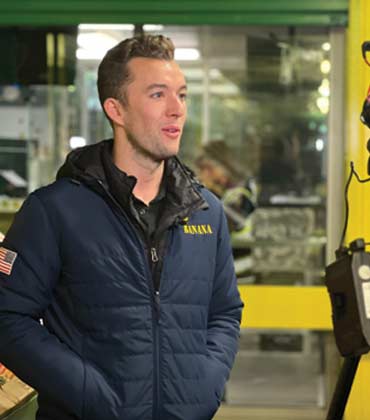
Daniel J. Barabino
Daniel J. Barabino, Chief Operating Officer at Top Banana, brings Big Four rigor to fresh produce, redefining waste reduction as the core operation by aligning ripening technology, data driven buying, and sustainability to deliver bananas with precision and responsibility.
Bananas don't wait. From the moment a box is loaded onto a vessel in Ecuador or Costa Rica, a clock starts running ” and every decision made between that farm and a consumer's kitchen counter is, at its core, a waste management decision. I came to the produce industry from a Big Four accounting firm. I'm comfortable with numbers, margins, and operational rigor. What I wasn't prepared for early on was just how physical and time-sensitive waste management is at the wholesale distribution level. In most industries, "waste reduction" is a strategy you layer onto operations. In bananas, waste reduction is the operation. The Ripening Room as a Waste Prevention Engine Top Banana is the only firm that ripens bananas directly inside the Hunts Point Terminal Market. That distinction isn't just a point of pride” it's the foundation of our entire waste reduction approach. Bananas are harvested fully green. Then we process them, which means the ripening room is not merely a processing step; it's the control point for the entire downstream shelf life of the product. Our facility runs Thermal Technologies ripening rooms alongside multi-zone cold storage. This investment expanded our ripening capacity and gave us the flexibility to manage volume and ripening specs without compromising timing. Each room is temperature and humidity controlled, with ethylene application managed so that fruit moves through the stages of ripeness on a schedule aligned with actual customer demand. A fluctuation of even a 10th of a degree can shift a ripening curve in ways that cost real money downstream and can lead to food waste. That responsibility demands real-time visibility, which is why we invested significantly in our ERP platform to integrate sales, warehouse, and ripening data into a single operational picture. For an industry not historically known for technological adoption, that integration is a major step forward leading to data-driven decisions leading to more precise results. Data-Driven Buying and the Category Expansion Challenge Over-buying is the original sin of perishable distribution. The temptation is always there ” a favorable price on large volume, a holiday surge to cover. But bananas purchased beyond what your customer base deamnds in any available ripening window become shrink. “We reduce waste by treating ripening as precision aligning technology data and sustainability to protect resources margins and deliver fruit responsibly from farm to kitchen.” Our weekly inventory and sales reporting infrastructure exists, in large part, to hone in our container building and ordering, backed by real-time sales and inventory data. By tracking sellthrough rates at the customer level, we build buying patterns that align closely with real demand ” precision buying that compresses the gap between what enters our facility and what exits as revenue rather than loss. This detailed managements also allows us to focus on category expansion underway in bananas. While it adds real complexity to the equation, we are anle to have visilnbility to manage the complexity. Organic banana sales have surged nearly year-overyear, and plantains are growing as well. Spcailty bananas are gaining traction in stores as a unique and differentiated offering at the stores as well suhc as babay bananas, manzano bananas and red bananas. Each category has its own demand curve, its own ripening behavior, its own customer segment. We treat organic as a distinct category now, speciality as another, consumer bags as one, banded fruit as another. Managing each with the same inventory discipline we apply to conventional fruit is essential to kepeing our operation running smoothly and reducing waste. Operational Efficiency and Waste Are the Same Problem Operational efficiency and food waste reduction are not separate objectives. They are the same problem, viewed from different angles. When we invest in better ripening technology, better software, and better buying discipline, we are simultaneously improving operations and reducing environmental food waste. That alignment between profitability and sustainability is not always how food waste reduction gets framed. Often it's presented as a cost responsible operators absorb. In fresh produce distribution, it's the opposite. The most succseful operators, in my opinon, run the leanest, most precise operations. The ripening room that holds temperature within half a degree isn't just protecting margin ” it's protecting every resource that went into producing that fruit before it ever arrived at our dock in the Bronx, all while satisfying customers ever changing deamnds. The industry trends reinforcing this are exciting: IoT-enabled chamber sensors, automated ethylene management systems, and non-destructive ripeness assessment tools are becoming operational necessities for all distributors. Operators who invest in this infrastructure will run tighter, less wasteful operations. Those who don't will manage waste by exception rather than by design. We move a lot of fruit that ultimately ends up in your home and, and we take that responsibility seriously to deliver an outstanding product.The articles from these contributors are based on their personal expertise and viewpoints, and do not necessarily reflect the opinions of their employers or affiliated organizations.
Top
