
THANK YOU FOR SUBSCRIBING


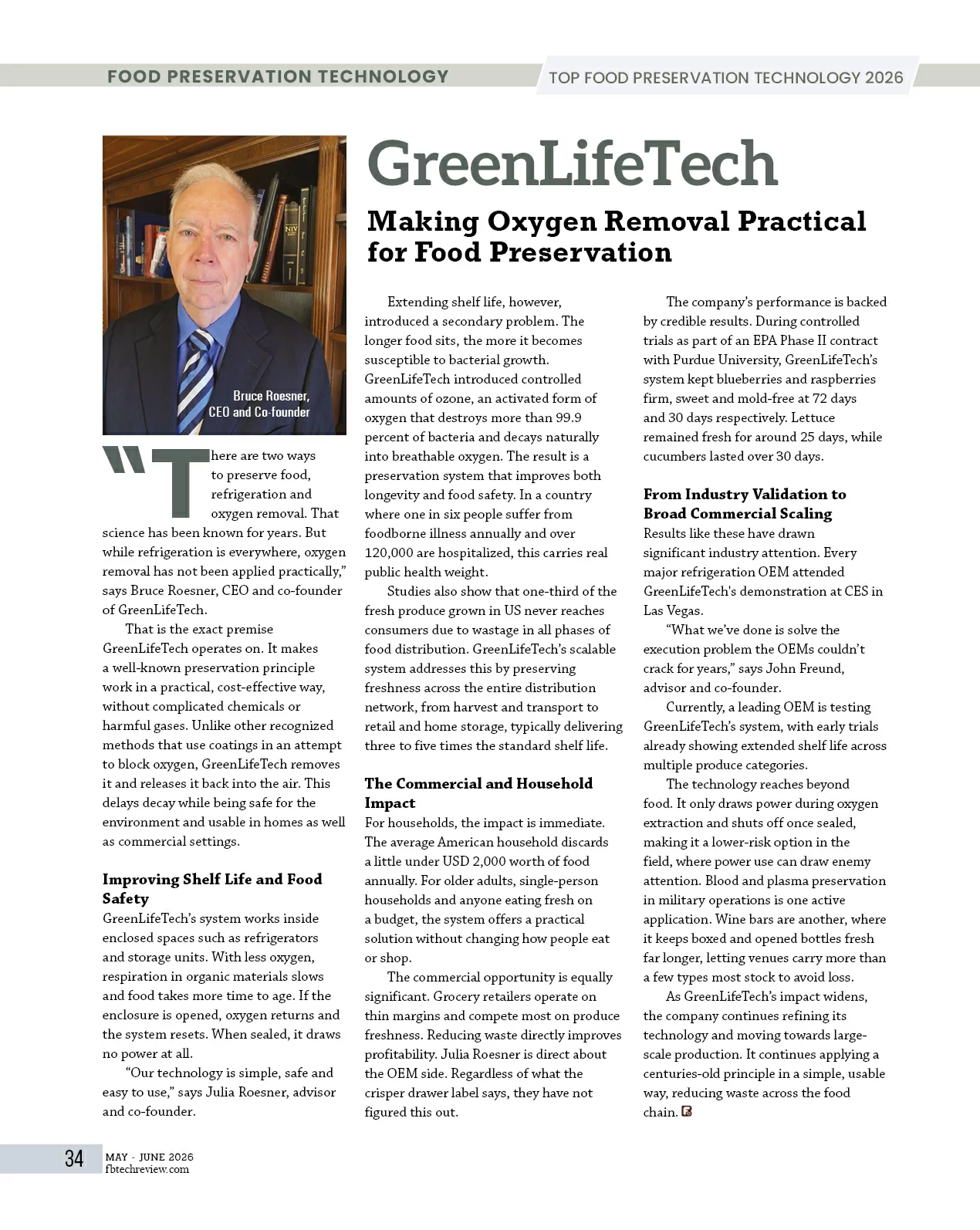
 Bruce Roesner, CEO and Co-founder
“There are two ways to preserve food, refrigeration and oxygen removal. That science has been known for years. But while refrigeration is everywhere, oxygen removal has not been applied practically,” says Bruce Roesner, CEO and co-founder of GreenLifeTech.
That is the exact premise GreenLifeTech operates on. It makes a well-known preservation principle work in a practical, cost-effective way, without complicated chemicals or harmful gases. Unlike other recognized methods that use coatings in an attempt to block oxygen, GreenLifeTech removes it and releases it back into the air. This delays decay while being safe for the environment and usable in homes as well as commercial settings.
Improving Shelf Life and Food Safety
How does the system function within enclosed environments to extend shelf life effectively?
GreenLifeTech’s system works inside enclosed spaces such as refrigerators and storage units. With less oxygen, respiration in organic materials slows and food takes more time to age. If the enclosure is opened, oxygen returns and the system resets. When sealed, it draws no power at all.
“Our technology is simple, safe and easy to use,” says Julia Roesner, advisor and co-founder.
Why is bacterial growth a concern when extending the storage duration of fresh food?
Extending shelf life, however, introduced a secondary problem. The longer food sits, the more it becomes susceptible to bacterial growth. GreenLifeTech introduced controlled amounts of ozone, an activated form of oxygen that destroys more than 99.9 percent of bacteria and decays naturally into breathable oxygen. The result is a preservation system that improves both longevity and food safety. In a country where one in six people suffer from foodborne illness annually and over 120,000 are hospitalized, this carries real public health weight.
-
There are two ways to preserve food, refrigeration and oxygen removal. That science has been known for years. But while refrigeration is everywhere, oxygen removal has not rarely been applied practically.
Studies also show that one-third of the fresh produce grown in US never reaches consumers due to wastage in all phases of food distribution. GreenLifeTech’s scalable system addresses this by preserving freshness across the entire distribution network, from harvest and transport to retail and home storage, typically delivering three to five times the standard shelf life.
The Commercial and Household Impact
In what way does the technology create measurable impact across households and commercial operations?
For households, the impact is immediate. The average American household discards a little under USD 2,000 worth of food annually. For older adults, single-person households and anyone eating fresh on a budget, the system offers a practical solution without changing how people eat or shop.
The commercial opportunity is equally significant. Grocery retailers operate on thin margins and compete most on produce freshness. Reducing waste directly improves profitability. Julia Roesner is direct about the OEM side. Regardless of what the crisper drawer label says, they have not figured this out.
The company’s performance is backed by credible results. During controlled trials as part of an EPA Phase II contract with Purdue University, GreenLifeTech’s system kept blueberries and raspberries firm, sweet and mold-free at 72 days and 30 days respectively. Lettuce remained fresh for around 25 days, while cucumbers lasted over 30 days.
From Industry Validation to Broad Commercial Scaling
Results like these have drawn significant industry attention. Every major refrigeration OEM attended GreenLifeTech's demonstration at CES in Las Vegas.
“What we’ve done is solve the execution problem the OEMs couldn’t crack for years,” says John Freund, advisor and co-founder.
Currently, a leading OEM is testing GreenLifeTech’s system, with early trials already showing extended shelf life across multiple produce categories.
The technology reaches beyond food. It only draws power during oxygen extraction and shuts off once sealed, making it a lower-risk option in the field, where power use can draw enemy attention. Blood and plasma preservation in military operations is one active application. Wine bars are another, where it keeps boxed and opened bottles fresh far longer, letting venues carry more than a few types most stock to avoid loss.
As GreenLifeTech’s impact widens, the company continues refining its technology and moving towards large-scale production. It continues applying a centuries-old principle in a simple, usable way, reducing waste across the food chain.
Rethinking Food Preservation beyond Refrigeration Limits
Food preservation decisions increasingly hinge on a mismatch between how supply chains move and how perishability accumulates. Fresh produce often deteriorates long before it reaches end consumption, yet accountability for waste is disproportionately assigned at the point of disposal rather than the point of degradation. This distortion complicates procurement strategy, particularly for executives managing cost exposure across sourcing, transport and retail environments. Extending usable shelf life is no longer a marginal efficiency play; it directly influences margin stability, inventory planning and waste liability across the entire chain.
Refrigeration has remained the dominant preservation method for decades, but its limitations are well understood. It slows biological processes without fundamentally altering the underlying drivers of decay.
Produce continues to respire, oxygen remains present, and microbial growth is only partially constrained. Alternative approaches have attempted to address these gaps through coatings or chemical interventions, yet these introduce tradeoffs related to safety perception, regulatory scrutiny and cost. The market has therefore lacked a practical method to intervene at the core mechanism of spoilage without introducing additional complexity.
A more grounded shift is emerging around controlled oxygen environments. The principle itself is not new; reducing oxygen exposure slows respiration and delays decay. The challenge has been execution. Systems capable of reliably extracting oxygen within everyday storage environments have historically been expensive, energy-intensive or impractical to scale. Any viable solution must operate across multiple points in the chain, from enclosed transport systems to retail storage and household appliances, without requiring behavioral change from end users or significant infrastructure redesign.
Performance validation in this space is increasingly measured through tangible shelf-life extension under real conditions. Outcomes are not theoretical; extensions of three to five times under controlled oxygen reduction have been consistently observed across produce types, though results remain dependent on initial freshness at the point of storage. This variability introduces a critical decision factor: preservation technologies must function as early as possible in the lifecycle to capture full value. Systems deployed only at the final stage, such as in-home storage, cannot compensate for prior degradation accumulated during transport or retail handling.
Microbial control presents a second constraint that cannot be separated from longevity. Extending shelf life increases exposure time, which raises susceptibility to bacterial growth. Solutions that address oxygen levels without managing microbial activity risk exchanging one failure mode for another. Integrated approaches that combine oxygen reduction with controlled antimicrobial mechanisms have demonstrated the ability to suppress bacterial growth at high levels while maintaining food safety standards. This dual control of respiration and contamination is becoming a defining capability rather than an optional enhancement.
Economic viability remains the final filter. Food preservation technologies must justify adoption across low-margin environments such as grocery retail and bulk distribution. Energy consumption, system durability and integration complexity directly affect deployment decisions. Technologies that require continuous power or complex mechanical systems impose long-term costs that undermine initial gains. Preference is shifting toward solutions that operate intermittently, activate only when environmental conditions change and avoid reliance on fragile components.
Within this context, GreenLifeTech positions its approach around the practical execution of oxygen-controlled preservation. It applies a system that removes oxygen within enclosed spaces, reducing respiration rates without relying on coatings or chemical treatments. Its design avoids continuous energy draw, activating primarily during oxygen extraction cycles, which supports cost efficiency in both commercial and consumer environments. The addition of controlled ozone enables simultaneous bacterial reduction, addressing food safety concerns while extending shelf life. Its applicability across refrigeration units, transport enclosures and storage environments reflects a scalable model aligned with how food moves rather than where waste is recorded.
...Read more
| |
Company
GreenLifeTech
Management
Bruce Roesner, CEO and Co-founder
Description
GreenLifeTech is a technology company that develops oxygen-reduction systems to extend the shelf life of food and other perishable products without using harmful chemicals. Its solutions remove oxygen from storage environments to slow spoilage, improve freshness and reduce waste across households and commercial supply chains.
Top
