
THANK YOU FOR SUBSCRIBING


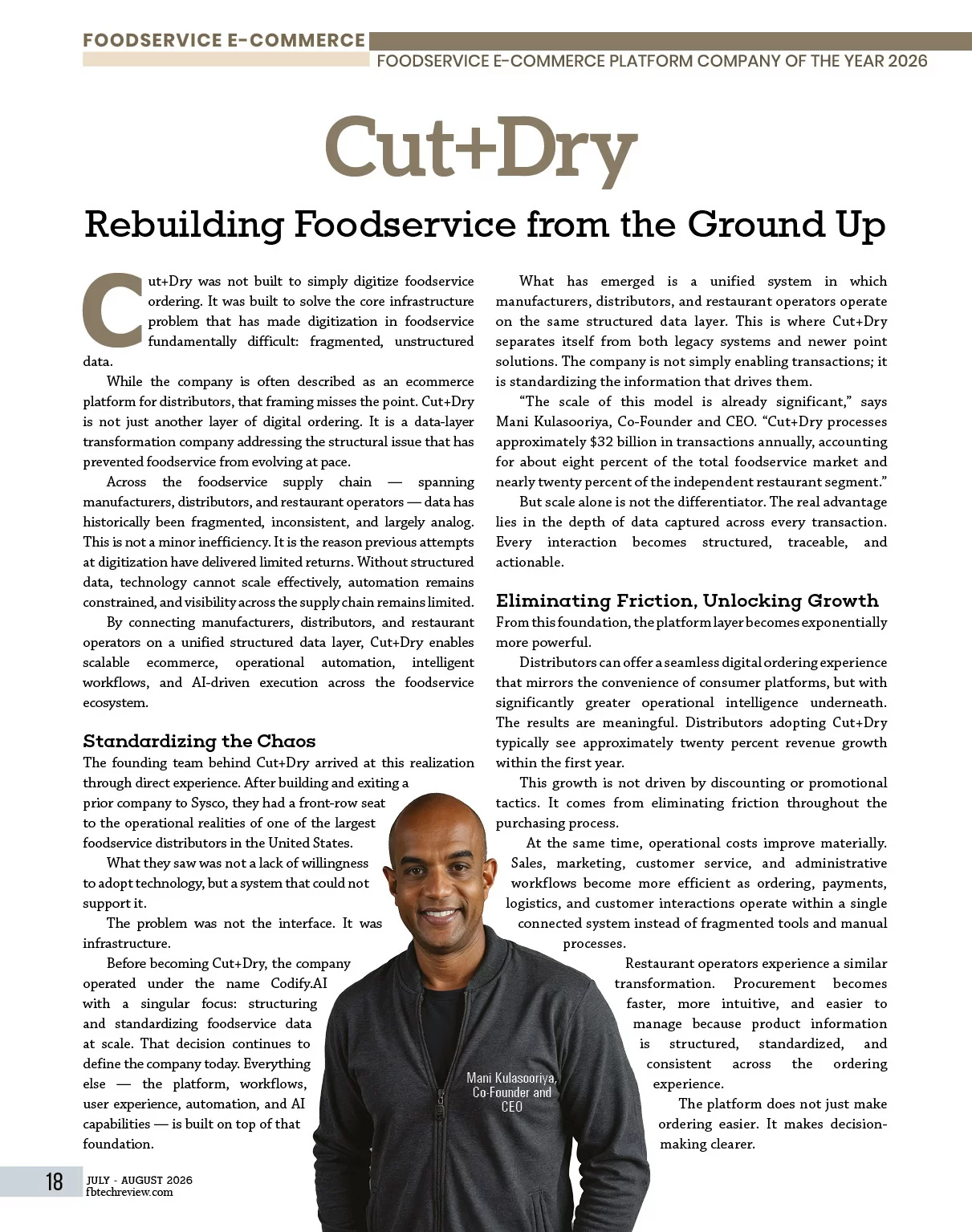
 Mani Kulasooriya, Co-Founder and CEO
While the company is often described as an ecommerce platform for distributors, that framing misses the point. Cut+Dry is not just another layer of digital ordering. It is a data-layer transformation company addressing the structural issue that has prevented foodservice from evolving at pace.
Across the foodservice supply chain — spanning manufacturers, distributors, and restaurant operators — data has historically been fragmented, inconsistent, and largely analog. This is not a minor inefficiency. It is the reason previous attempts at digitization have delivered limited returns. Without structured data, technology cannot scale effectively, automation remains constrained, and visibility across the supply chain remains limited.
By connecting manufacturers, distributors, and restaurant operators on a unified structured data layer, Cut+Dry enables scalable ecommerce, operational automation, intelligent workflows, and AI-driven execution across the foodservice ecosystem.
Standardizing the Chaos
The founding team behind Cut+Dry arrived at this realization through direct experience. After building and exiting a prior company to Sysco, they had a front-row seat to the operational realities of one of the largest foodservice distributors in the United States.
What they saw was not a lack of willingness to adopt technology, but a system that could not support it.
The problem was not the interface. It was infrastructure.
Before becoming Cut+Dry, the company operated under the name Codify.AI with a singular focus: structuring and standardizing foodservice data at scale. That decision continues to define the company today. Everything else — the platform, workflows, user experience, automation, and AI capabilities — is built on top of that foundation.
What has emerged is a unified system in which manufacturers, distributors, and restaurant operators operate on the same structured data layer. This is where Cut+Dry separates itself from both legacy systems and newer point solutions. The company is not simply enabling transactions; it is standardizing the information that drives them.
“The scale of this model is already significant,” says Mani Kulasooriya, Co-Founder and CEO. “Cut+Dry processes approximately $32 billion in transactions annually, accounting for about eight percent of the total foodservice market and nearly twenty percent of the independent restaurant segment.”
But scale alone is not the differentiator. The real advantage lies in the depth of data captured across every transaction. Every interaction becomes structured, traceable, and actionable.
Eliminating Friction, Unlocking Growth
From this foundation, the platform layer becomes exponentially more powerful.
Distributors can offer a seamless digital ordering experience that mirrors the convenience of consumer platforms, but with significantly greater operational intelligence underneath. The results are meaningful. Distributors adopting Cut+Dry typically see approximately twenty percent revenue growth within the first year.
-
Cut+Dry processes approximately $32 billion in transactions annually, accounting for about eight percent of the total foodservice market and nearly twenty percent of the independent restaurant segment.
This growth is not driven by discounting or promotional tactics. It comes from eliminating friction throughout the purchasing process.
At the same time, operational costs improve materially. Sales, marketing, customer service, and administrative workflows become more efficient as ordering, payments, logistics, and customer interactions operate within a single connected system instead of fragmented tools and manual processes.
Restaurant operators experience a similar transformation. Procurement becomes faster, more intuitive, and easier to manage because product information is structured, standardized, and consistent across the ordering experience.
The platform does not just make ordering easier. It makes decision-making clearer.
Making Demand Measurable
The most underappreciated impact, however, is on manufacturers.
In traditional foodservice, manufacturers operate at a distance from demand. They lack visibility into who is buying their products and have limited ability to influence those decisions.
Cut+Dry changes this dynamic by creating a direct, data-driven connection to the point of purchase.
Manufacturers can now engage with demand in a targeted, measurable way without disrupting the distributor relationship. Because the platform operates on clean, unified data, campaign performance becomes measurable down to the SKU and operator level.
The results are substantial. Campaigns executed on the platform generate an average return on advertising spend of approximately nine times, with some campaigns reaching fourteen to fifteen times ROAS.
These outcomes are not simply the result of better advertising tools. They are structurally enabled by the presence of clean, unified data.
This data-first approach has also driven broader industry validation. UniPro, the largest independent foodservice distribution cooperative in the United States, selected Cut+Dry to power its supplier connectivity platform — reinforcing the idea that structured data is no longer optional within foodservice. It is foundational.
Not Just Integrated—Intelligent
The platform’s integrated architecture reinforces this advantage. Unlike point solutions that address isolated functions, Cut+Dry brings ordering, payments, CRM, and logistics into a single system.
This integration is not simply about convenience. It ensures every workflow operates on the same underlying data layer, eliminating inconsistencies while enabling automation and intelligence across the system.
That foundation becomes even more valuable in the context of artificial intelligence.
AI is only as effective as the data it operates on. In fragmented environments, AI produces fragmented outcomes. In structured environments, it becomes transformative.
Cut+Dry is already moving in this direction through products like Yes Chef, which leverage structured public and proprietary data to automate complex sales and operational workflows. Tasks that once required days of manual effort can now be completed in minutes.
More importantly, the direction of the industry is becoming increasingly clear. Technology is shifting from simply assisting human workflows to actively executing them.
Closing the Gap between Technology and Foodservice
Foodservice has historically evolved slowly, while technology — particularly AI — is advancing at an accelerating pace. The gap between the two continues to widen.
Companies operating on fragmented systems will struggle to adopt emerging technologies effectively. Companies operating on structured data foundations will be able to move faster, automate more intelligently, and adapt more efficiently.
As Kulasooriya explains, “We are not just an e-commerce platform for food service distributors. We are a digital platform that connects manufacturers, distributors, and restaurant operators together on the same unified structured data across the entire platform.”
That statement captures the essence of Cut+Dry’s positioning. The company is not competing on features or interfaces. It is competing at the infrastructure level.
By solving the data problem first, Cut+Dry has created a system where every subsequent layer — commerce, operations, payments, automation, and AI — becomes significantly more effective.
Structured Data as Foodservice’s Defining Advantage
In an industry where margins are tight and complexity is high, this distinction matters. Structured data is not simply an operational improvement. It is a competitive advantage.
It determines how efficiently businesses operate, how effectively they scale, and how quickly they can adopt the next generation of technology.
Cut+Dry’s role is not to introduce change for its own sake, but to make that advantage accessible. By rebuilding foodservice on a structured data foundation, it is enabling a shift that the industry has long needed but has been unable to execute.
And in a market where most players still operate on fragmented data, the ability to act on clean, unified data is not just an upgrade. It is the difference between keeping up and pulling ahead.
Structuring Commerce in Foodservice: A New Standard for Digital Trade
Foodservice distribution has long operated under constraints that limit the effectiveness of digital transformation. Transactions move across manufacturers, distributors and operators through fragmented systems, often supported by analog workflows and inconsistent product data. Digital tools layered on top of this environment tend to replicate inefficiencies rather than resolve them. The result is a sector where ordering remains cumbersome, visibility is limited, and decision-making lacks precision despite the scale of activity.
The challenge is not simply the absence of technology but the absence of structured data to support it. When product information, pricing and transaction records are inconsistent or unstandardized, downstream systems cannot deliver meaningful improvements in purchasing, sales or marketing. Digital storefronts without this foundation risk becoming superficial interfaces rather than engines of growth. For executives evaluating foodservice e-commerce platforms, the distinction between interface-driven solutions and data-driven platforms becomes critical.
A more effective approach begins with unifying data across the supply chain so that every transaction is captured with clarity and consistency. When product attributes, pricing and buyer behavior are standardized, platforms can deliver measurable gains in both revenue and cost control. Distributors benefit from higher order frequency and simplified purchasing journeys while reducing the administrative burden associated with manual processes. Restaurants gain the ability to search, compare and order with the same ease they experience in consumer commerce, which directly influences purchasing patterns.
Equally important is the ability to connect all participants in the supply chain within a single environment. Platforms that treat distributors, manufacturers and operators as isolated users fail to unlock the full economic value of digital commerce. A unified system allows manufacturers to understand demand signals at a granular level and engage buyers in ways that were previously unavailable in foodservice. This visibility introduces a level of targeting and measurement that aligns more closely with modern digital commerce practices, without disrupting existing relationships.
"Foodservice e-commerce platforms that unify and standardize supply chain data enable greater visibility, more informed decision-making and measurable improvements in operational efficiency."
The structure of the platform itself also shapes long-term outcomes. Point solutions that address ordering, payments or customer management independently create fragmented user experiences and dilute data quality. When these functions are integrated within a single system, every interaction contributes to a shared dataset, improving efficiency and enabling more informed decisions. This integration becomes especially relevant as advanced technologies rely on clean, centralized data to function effectively.
Cut+Dry reflects this shift toward a data-first, platform-driven model. While it presents itself as an e-commerce solution for foodservice distributors, its core strength lies in structuring and connecting data across the supply chain. It operates on a unified data layer that captures detailed transaction-level information between manufacturers, distributors and restaurant operators, enabling a level of visibility that traditional systems cannot provide.
"Cut+Dry connects manufacturers, distributors and restaurant operators through a unified data platform that integrates ordering, payments, customer management and logistics into a single digital ecosystem."
This foundation allows it to deliver tangible outcomes. Distributors using the platform typically experience meaningful increases in order volume while reducing selling and service costs through digitized workflows. Manufacturers can influence purchasing decisions with measurable precision, backed by direct insights into buyer behavior. Its integrated environment combines ordering, payments, customer management and logistics, ensuring that every function contributes to a consistent data structure. The result is not only improved efficiency but a scalable framework that supports advanced automation and intelligent decision-making, positioning it as a leading choice for organizations aiming to modernize foodservice commerce.
...Read more
Foodservice E-Commerce Platform Companies Info
Q1
What Should Buyers Expect from Foodservice E-commerce Platforms?
Foodservice e-commerce platforms should do more than replace phone calls with online ordering. In foodservice, the bigger challenge is keeping product information, pricing, payments and fulfillment data aligned so distributors, manufacturers and restaurant operators are working from the same information. When data is inconsistent, it can lead to ordering mistakes, unnecessary substitutions and extra follow-up. Most businesses already have systems in place. The real question is whether those systems work together effectively. Strong platforms reduce friction by making catalogs easier to search, orders easier to repeat and purchasing activity easier to track.
Q2
How Does Cut+Dry Approach Foodservice Commerce Differently?
Fragmented product information is the challenge Cut+Dry was built to address. Before becoming Cut+Dry, the company operated as Codify.AI, focusing on structuring foodservice data at scale. Its model connects manufacturers, distributors and restaurant operators through a shared data layer, then builds commerce, payments, CRM, logistics and AI workflows on top of it. This makes foodservice e-commerce platforms about more than digital storefronts. It creates the foundation that supports every transaction.
Q3
Why Does Structured Product Data Matter in Digital Ordering?
Restaurant buyers do not have time to sort through incomplete catalogs or search for missing product details during a busy purchasing cycle. Foodservice e-commerce platforms rely on accurate item records, images, attributes, nutrition information, pricing and availability to help buyers make decisions quickly. When data is inconsistent, even a modern ordering experience can create extra manual work. Structured data turns a catalog into a practical tool that customers, sales teams and suppliers can rely on.
Q4
What Value Do These Platforms Create for Distributors and Restaurants?
Distributors need digital ordering tools that strengthen customer relationships rather than replace them with a generic online experience. Foodservice e-commerce platforms can support around-the-clock ordering, product discovery, order history, payments and sales visibility while preserving distributor pricing and service relationships. Restaurants benefit from a simpler way to reorder products, compare options and manage invoices. Sales representatives also gain visibility into customer activity before the next conversation instead of piecing it together afterward.
Q5
How Should Manufacturers Evaluate Commerce Connectivity?
Manufacturers should look beyond promotional placement and ask whether product demand can be measured at the SKU, distributor and operator level. Foodservice e-commerce platforms deliver the most value when they connect marketing activity to actual purchasing behavior without disrupting distributor relationships. A strong model should show where products are discovered, who is buying them and how campaigns perform. That insight is often more valuable than a demonstration built on ideal conditions. Item-level reporting gives sales teams clearer direction on what to adjust next.
Q6
What Should Buyers Notice About Cut+Dry's Model?
Scale provides valuable context. Cut+Dry processes approximately $32 billion in annual transactions and has been selected by UniPro to support supplier connectivity across a large independent distribution network. The company also distributes product data across more than 450 distributors and over 160,000 transacting operators. For buyers evaluating foodservice e-commerce platforms, those figures point to a system built around shared data rather than a simple ordering tool.
| |
Company
Cut+Dry
Management
Mani Kulasooriya, Co-Founder and CEO
Description
Cut+Dry is transforming foodservice by structuring fragmented data into a unified digital platform. By connecting manufacturers, distributors, and operators, the company enables measurable growth, operational efficiency, and AI-driven execution, reshaping how the industry buys, sells, and scales in a data-first era.
Top
