THANK YOU FOR SUBSCRIBING

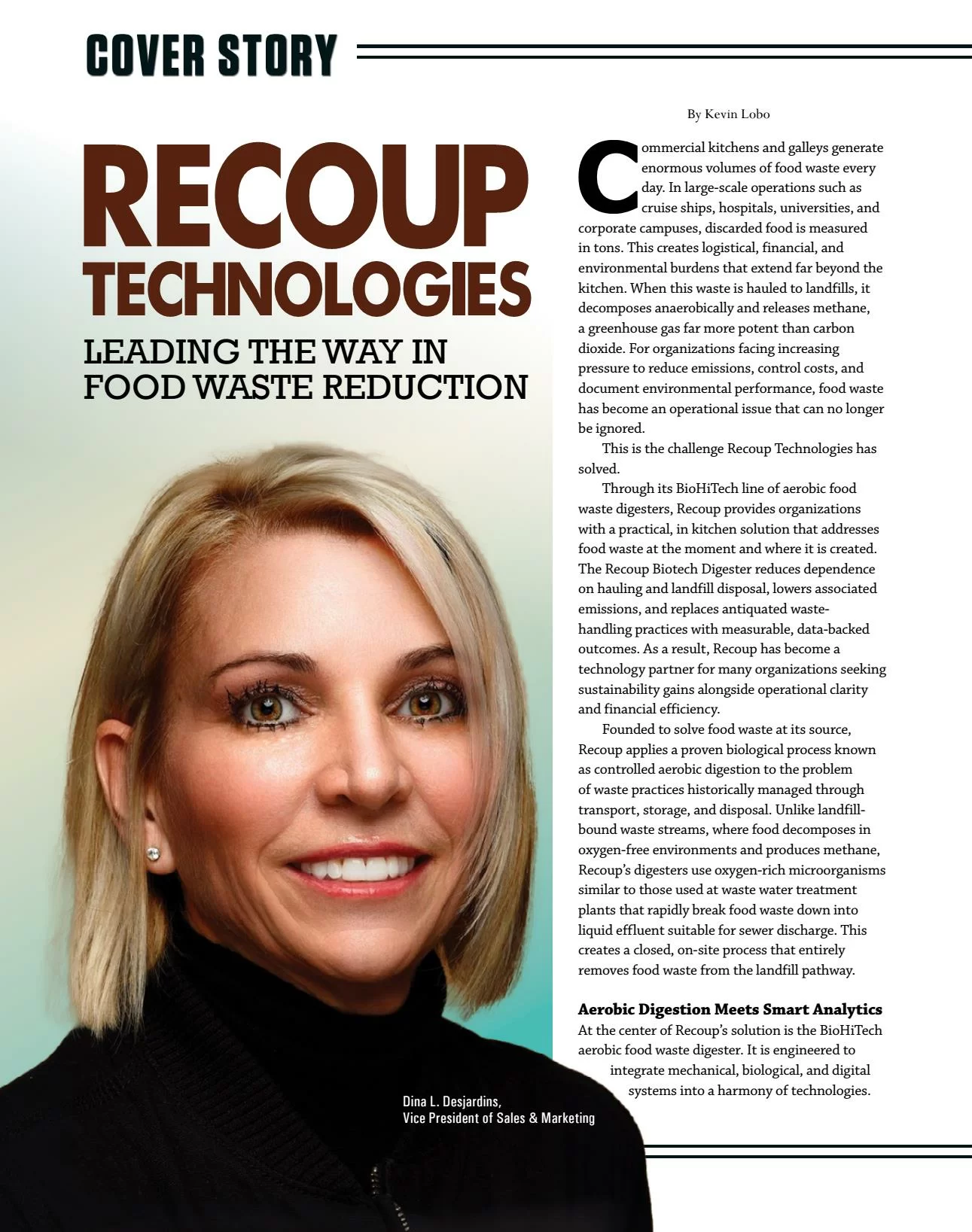
 Dina L. Desjardins, Vice President of Sales & Marketing
This is the challenge Recoup Technologies has solved.
Through its BioHiTech line of aerobic food waste digesters, Recoup provides organizations with a practical, in kitchen solution that addresses food waste at the moment and where it is created. The Recoup Biotech Digester reduces dependence on hauling and landfill disposal, lowers associated emissions, and replaces antiquated waste-handling practices with measurable, data-backed outcomes. As a result, Recoup has become a technology partner for many organizations seeking sustainability gains alongside operational clarity and financial efficiency.
Founded to solve food waste at its source, Recoup applies a proven biological process known as controlled aerobic digestion to the problem of waste practices historically managed through transport, storage, and disposal. Unlike landfill-bound waste streams, where food decomposes in oxygen-free environments and produces methane, Recoup’s digesters use oxygen-rich microorganisms similar to those used at waste water treatment plants that rapidly break food waste down into liquid effluent suitable for sewer discharge. This creates a closed, on-site process that entirely removes food waste from the landfill pathway.
Aerobic Digestion Meets Smart Analytics
At the center of Recoup’s solution is the BioHiTech aerobic food waste digester. It is engineered to integrate mechanical, biological, and digital systems into a harmony of technologies.
From a mechanical standpoint, the system contains, mixes, aerates, and processes food waste to maintain optimal digestion conditions. Biologically, it relies on naturally occurring aerobic microorganisms that metabolize food waste without chemicals or additives. These natural and safe organisms convert organic solids into water and inert material. This oxygen-based process suppresses methane-producing bacteria and mirrors our own natural digestion in a controlled and accelerated environment right in commercial kitchens and galleys.
What differentiates Recoup’s approach is the software layer integrated into this biological process. Each BioHiTech digester connects to Recoups patented, cloud-based platform that captures and analyzes waste data in real time. Every disposal event is weighed, categorized, and time-stamped at the source. This creates a detailed record of what is being wasted, when it occurs, and where it originates. Food waste shifts from an unseen byproduct to an operational dataset to be managed.
Richard Pruitt, a cruise industry veteran with more than 25 years of experience and former vice president at Carnival, has worked with Recoups the technology operating at scale in cruise ships, one of the most demanding environments in the world. He notes that the system reduces methane and carbon emissions, eases galley staff workload, provides additional counter space, eliminates foreign objects being processed, and delivers consistent and precise waste analysis. From a financial perspective, he adds that BioHiTech digesters compare favorably with traditional land-based food waste transport and disposal methods in the short term while eliminating those costs entirely in maritime applications.
This combination of biological processing and digital intelligence allows organizations to move beyond waste removal to significant waste reduction. By tracking trends across departments or locations, kitchen management can identify overproduction, spoilage and diversion inefficiencies that drive unnecessary cost and environmental impact.
-
Our BioHiTech digesters have proven time and time again to offer the cleanest, most efficient food waste processing technology, working in the toughest conditions on the globe 24/7/365. As important as a dishwasher, deepfryer, grilltop, or refrigerator, if every commercial kitchen or galley had our BioHiTech digester, there wouldn’t be a food waste generated landfill methane problem.
This combination of biological processing and digital intelligence allows organizations to move beyond waste removal to significant waste reduction. By tracking trends across departments or locations, kitchen management can identify overproduction, spoilage and diversion inefficiencies that drive unnecessary cost and environmental impact.
Environmental Impact with Operational Returns
Recoup Technologies’ adoption across education, hospitality, healthcare, and maritime sectors reflects growing demand for solutions that deliver measurable environmental benefits and added operational efficiency. By processing food waste in the kitchen, BioHiTech digesters eliminate the need for refrigerated waste storage, frequent hauling, and the emissions associated with transport logistics.
 For F&B executives managing tight budgets alongside sustainability commitments, this technology carries direct financial benefits. Reduced hauling frequency lowers trucking fuel and labor costs, while on-site digestion minimizes health, safety, and pest-control risks associated with stored food waste. Energy consumption is low comparable to three standard light bulbs. This makes the technology one of the most energy-efficient options available, especially when compared with composting, anaerobic digestion, or dehydration technologies.
At Villanova University, these operational factors played a central role in the decision to deploy BioHiTech digesters. Al Motel, Waste and Recycling Manager and TRUE Advisor for Zero Waste, explains that the system fit within existing space constraints while offering capabilities competitors could not match. Recoup's patented cloud data platform provided real-time visibility into cost savings and environmental impact, allowing the university to document return on investment alongside sustainability progress.
John Dorscht, president and CEO of Recoup Technologies, points to the system’s performance under continuous real-world use. “BioHiTech digesters have operated around the clock in high-volume kitchens and galleys worldwide.” He emphasizes that broader adoption would significantly reduce methane emissions tied to food waste while lowering operating costs for the organizations responsible for managing it.
Addressing Food Waste at the Source
Traditional waste systems measure outcomes after waste has been mixed, stored, and removed. Recoup’s technology disrupts that sequence by capturing data at the moment food waste is generated.
Each tub disposed into a BioHiTech digester is recorded by an integrated load-cell scale system that records precise weight data. Kitchen staff can classify the waste type through a simple interface before disposal. This links category, weight, time, and location into a single data point. The information is transmitted to Recoup's patented cloud platform every 30 seconds, creating a continuous source-level record of food waste activity.
This approach allows organizations to identify patterns that were previously invisible. These include menu items that are consistently overproduced, spikes in waste at specific times of day, or recurring spoilage tied to ordering practices. The digester functions not only as a processing unit but also as a decision-support tool that informs procurement, menu planning, and operational policy.
By closing the loop between identification and processing, Recoup enables organizations to reduce waste upstream. Prevention becomes the primary lever for both cost savings and emissions reduction.
Verifiable Data, Not Assumptions
As sustainability reporting requirements expand, organizations face increased scrutiny over how environmental claims are measured and supported. Recoup’s platform addresses this challenge by producing auditable, source-level data, rather than estimates or proxy metrics.
Every pound of food waste processed is logged, categorized, and stored within the cloud system. This creates a defensible record suitable for ESG disclosures, landfill diversion reporting, and internal audits. Emissions reductions can be calculated using recognized landfill and transportation emission factors, aligning operational data with established reporting frameworks.
This focus on measurement shifts sustainability from aspiration to hard data reporting and transparent accountability. Performance trends remain visible over time, allowing organizations to track improvement, identify setbacks, and refine operational strategies accordingly. And reporting can be viewed on any online device, smartphone, tablet, desktop or report screen.
A Smarter Path Forward
As food costs rise, regulations tighten, waste disposal costs rise and ESG expectations mature, organizations are rethinking how waste fits into broader operational models. Recoup Technologies positions food waste management not as a downstream service but as a core operational system located right in the kitchen that intersects with finance, compliance, and sustainability strategy.
With plans to expand analytics capabilities and deepen integration with kitchen, inventory, and procurement platforms, Recoup’s technology continues to evolve alongside the needs of complex organizations. The objective remains consistent: to make food waste visible, measurable, and preventable.
In an industry long defined by hauling schedules and disposal fees, Recoup Technologies offers a better model. Food waste is addressed in the kitchen, where it begins, data replaces assumptions, and sustainability all work in harmony to deliver tangible operational value.
The Rise of Data-Led Food Waste Digestion in Commercial Kitchens
Food waste has become one of the most persistent cost and sustainability challenges facing large-scale kitchens, galleys and institutional foodservice operations. Disposal practices that once felt routine now sit under tighter regulatory oversight, sharper ESG scrutiny and rising operational expense. Executives evaluating modern food waste digestion solutions are no longer focused only on diversion rates. Attention has shifted toward how waste is handled at the point of generation, how environmental claims are substantiated and how waste intelligence feeds broader decision-making across procurement, menu design and compliance reporting.
A defining pressure in this market is methane exposure. When food waste leaves the facility and enters landfill pathways, anaerobic decomposition produces methane emissions that significantly outweigh carbon dioxide in climate impact. Solutions that merely relocate waste, rather than changing how it is processed, leave this liability largely intact. Increasingly, buyers favor systems that neutralize methane risk directly at the source while simplifying daily kitchen workflows.
Another point of separation lies in visibility. Many waste strategies fail because organizations lack precise insight into what is being discarded, when and why. Back-end audits and estimates rarely drive lasting change. Systems that capture weight, type and timing at disposal offer a clearer foundation for reducing overproduction, adjusting purchasing behavior and defending sustainability claims under audit. This shift toward source-level intelligence reflects a broader move away from symbolic sustainability toward verifiable outcomes.
Operational practicality also matters. Space constraints, odor control, labor burden and hauling logistics often determine whether a solution is adopted or abandoned. Buyers increasingly expect digestion technologies to integrate directly into the kitchen environment, operate continuously and reduce handling rather than add new steps. Energy and water use, once secondary considerations, now factor into total environmental and cost assessments as well.
Against this backdrop, Recoup Technologies stands out as a reference point for how aerobic digestion, data capture and cloud oversight can converge into a single system. Its solution processes food waste on-site using oxygen-dependent microorganisms that mirror natural decomposition while preventing methane formation. Food waste is converted into greywater suitable for sewer discharge, eliminating the landfill pathway entirely and removing the need for storage, refrigeration, or hauling.
What elevates the platform beyond disposal is how waste is measured and interpreted. Each loading event is weighed and classified at the moment it occurs, tying volume, type and time together before digestion begins. That information flows into a cloud-based environment where it is aggregated across kitchens or locations, producing a defensible record of waste generation and reduction. This enables operators to trace waste back to specific behaviors, shifts or menu decisions and act upstream, where financial and environmental gains are most durable. The system’s remote monitoring and control capabilities further strengthen its appeal for multi-site operators. Performance oversight, troubleshooting and reporting do not depend on local intervention, which supports consistency across distributed facilities.
For organizations evaluating food waste digestion solutions, the strongest options are no longer defined solely by diversion. The market is rewarding systems that prevent methane at the source, simplify daily operations and convert waste into actionable intelligence. Recoup Technologies exemplifies this direction by combining aerobic digestion with real-time measurement and cloud analytics, offering a disciplined, data-backed path to food waste reduction that extends beyond disposal and into smarter operational control.
...Read more
| |
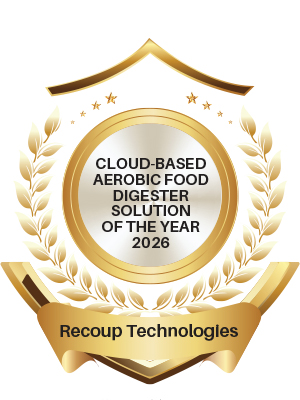
Company
Recoup Technologies
Management
Dina L. Desjardins, Vice President of Sales & Marketing and John Dorscht, President and CEO
Description
Recoup Technologies is pioneering a sustainable solution to food waste with its BioHiTech aerobic digesters. By combining natural digestion processes with smart cloud-based analytics, Recoup helps businesses reduce waste, lower carbon footprints, and achieve measurable sustainability, all while cutting operational costs.
Top
